As debate grows across the UK about how early careers education should begin, Scotland already has a strong national network connecting young people with employers and the world of work.
Former MP Alan Milburn, author of a major report into youth unemployment in the UK, has called for children to learn about different careers from primary school age, with work experience placements made mandatory for 14- to 16-year-olds. His comments have renewed focus on how young people can gain earlier, more meaningful exposure to future pathways.
While questions remain about how such proposals would work in practice, particularly given the pressures already facing schools, Scotland has spent more than a decade building an employer-led infrastructure to support this kind of engagement.
Developing the Young Workforce (DYW) was established in 2014 in response to rising youth unemployment. Funded by the Scottish Government and delivered through 20 employer-led Regional Groups, DYW connects employers with young people through close partnership with schools, local authorities, colleges and skills partners.
Since 2020, further investment has ensured that every publicly funded secondary school has a member of staff with a remit to facilitate DYW activity between employers and young people.
In the 2025/26 academic year, DYW Regional Groups worked with more than 6,500 employers, delivered more than 16,000 employer-led activities, and supported more than 450,000 attendances by young people.
That reach matters at a time when Scotland needs more young people to understand the opportunities available to them, more employers to help shape the future workforce, and stronger connections made between education, skills and the economy.
Across Scotland, DYW activity gives young people practical insight into careers and pathways they may not otherwise have known about. Earlier in 2026, DYW North Highland’s Step Into STEM activity connected 420 S1 to S3 pupils with 15 employers across six schools.
In Glasgow, the award-winning Construction Aware programme gives pupils in S3 to S5 practical experience with construction employers through site visits, skills-based activities and direct engagement with staff. Since launching in 2024/25, the initiative has engaged more than 30 employers, and up to 450 young people will take part this year.
Although DYW primarily delivers through Scotland’s secondary schools, it also supports primary schools to introduce children to the world of work. In 2025/26, DYW facilitated 142 employer-led activities for primary pupils, connecting 216 employers with more than 10,000 young people.
In the Scottish Borders, more than 1,200 Primary 6 pupils attended an Inspire Learning Festival in June 2026, where employers including NHS Borders, Morrison Construction, the RAF and Plexus helped pupils explore links between classroom learning, digital technology and future careers.
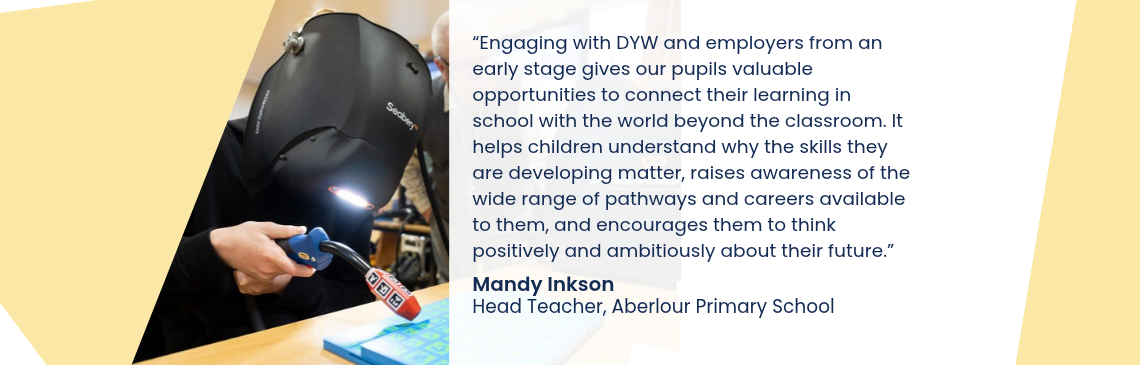
Mandy Inkson, Head Teacher at Aberlour Primary School, said early engagement with employers helps pupils connect their learning with life beyond the classroom:
“Engaging with DYW and employers from an early stage gives our pupils valuable opportunities to connect their learning in school with the world beyond the classroom. It helps children understand why the skills they are developing matter, raises awareness of the wide range of pathways and careers available to them, and encourages them to think positively and ambitiously about their future.
“Bringing employers into our curriculum makes learning more relevant, meaningful and engaging, while helping pupils develop important skills such as communication, teamwork, problem-solving and confidence. Starting these conversations in the primary years is incredibly important – it broadens horizons, challenges stereotypes and helps every child begin to recognise their own strengths, interests and potential.”
Sandy Begbie CBE, Chair of the DYW Employers Forum and Chief Executive of Scottish Financial Enterprise, said:
“Scotland has built a strong foundation for school-employer engagement through Developing the Young Workforce. Across the country, employers, schools and local partners are giving young people practical experiences that build confidence, develop skills and open their eyes to future opportunities.
“That matters. The more meaningful interactions young people have with employers before they leave school, the more likely they are to move into and sustain positive destinations beyond school.
“DYW’s employer-led Regional Groups are central to making that happen in communities across Scotland, providing the local relationships, employer insight and practical support that help schools and businesses work together effectively.
“We should be proud of what has been built, but ambitious about what comes next. If every young person is to understand the opportunities open to them, and employers are to play a stronger role in developing Scotland’s future workforce, DYW must continue to be backed, strengthened and embedded as a vital part of Scotland’s education and skills landscape.”
Tertiary Education Minister Alyn Smith said:
“The Scottish Government is delivering a comprehensive range of interventions to support young people into learning and work, from curriculum to careers support and employability.
“Developing the Young Workforce is central to this, giving young people in every secondary school access to careers events, workplace visits and employer engagement that broaden horizons and build confidence, particularly for those with limited exposure to the world of work. Increasingly, this engagement is starting even earlier, with DYW now connecting primary pupils with employers too.
“DYW Regional Groups also highlight the full range of pathways available, strengthening the connection between education and the labour market.
“Together, these interventions help young people build the skills and connections they need, while supporting employers to develop the workforce Scotland needs now and in future.”